


Asian Koel Eudynamys scolopacea
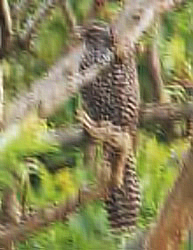
One female, apparently of the subspecies chinensis, May 28th 2001, Gageo Island, Jeollanam Do.
Although the weather seemed unexceptional (sunny spells with banks of fog and little wind), many migrants were arriving at Hang Ri, the northwestern tip of Gageo Island, with about 15 locustella warblers (including one apparent Pallas’s/Middendorf’s Grasshopper Warbler Locustella certhiola subcerthiola or L. ochotenis subcerthiola) and 3 Brown Shrikes Lanius cristatus recorded in the late afternoon of May 28th 2001.
Most puzzling was a very large cuckoo type watched flying across an arable plot near the headland. It immediately suggested an Asian Koel, but when it landed in a low tree at about 40 m range it showed a distinct pale supercilium and much heavier spotting than any previously seen by Nial Moores in South-East Asia on visits to e.g. Thailand or Malaysia.
It slowly and methodically started to pick at caterpillars. Nial Moores took photographs with a hand-held camera through a Nikon telescope, for the 30 seconds that the bird could be seen, when it appeared (1) extremely long-tailed, with (2) strikingly dark (blackish) upperparts, that were (3) heavily speckled white, with (4) a similarly patterned head, showing (5) an emergent pale supercilium and (6) a paler submoustachial stripe. The primaries were slightly browner, the tail was (7) barred dark grey and white, and (8) the underparts, though not well seen, appeared from the side to be barred. (9) The bill was noted as grey, tinged greenish, and (10) the eye was red.The photographs, though blurred, clearly reveal the same features, several of which are diagnostic of Asian Koel. Reference to Robson (2000) identified this individual to the distinctive subspecies chinensis, a form more strikingly speckled white with a stronger supercilium than e.g. malayana of South-East Asia.
Described by MacKinnon and Phillipps (2000) as a summer breeder in most of China south of 35 degrees North, the Asian Koel probably occurs regularly to within less than 1000 km of Gageo Island, and as such could be expected to occasionally wander to Korea.