


Himalayan Swiftlet Collacalia brevirostris Subsp. innominata
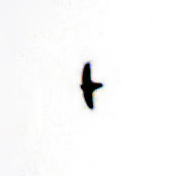
Photo © Nial Moores
First recorded on May 3, 2001, Gageo Island, Jeollanam Province.
Subsequently recorded (and poorly photographed) on Eocheong Island, Gunsan City, Jeollabuk Province, on April 18th and 19th.
A further swiftlet, presumably this species, was recorded on 22nd with 6 claimed by one observer (not NM) on April 23rd, 2002, also on Eocheong Island.
One autumn record, August 25th 2002, Eocheong Island.
An afternoon arrival of migrants at Hang Ri, in the northwest of Gageo Island on May 3 2001 included a flock of about 20 Asian House Martin Delichon dasypus. Loosely following this flock was a single swiftlet, seen at about 30 m range through 8x40 Nikon binoculars, for probably about 3 seconds in bright evening light. Although the views were extremely brief, the bird was (1) dark brown overall, but showed (2) a clear milk coffee colored rump, and (3) a slight tail cleft. The bird appeared (4) capped darker and (5) the "face" slightly paler brown. The wings were (6) obviously narrower, (7) the body shorter and (8) the flight more batlike than the seasonally ever-present Pacific Swifts Apus pacificus that breed there.
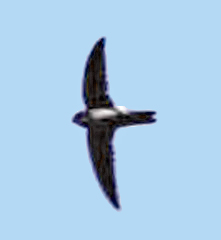
As NM also found one of the first individuals in Japan (a well photographed individual on an island offshore from Fukuoka city on May 9th 1997, see image right, photo © OKABE Hiroto), he had consequently researched the identification features thoroughly and identification was rapid. The small size and rapid bat-like flight eliminated all other swift species, along with its dark brown, rather than white rump, identifying it specifically as Himalayan Swiftlet. In addition, the obviousness of the rump-patch very strongly suggests that both the Japanese and the Gaego island individuals belong to the migratory innominata subspecies, sometimes referred to as Chinese Swiftlet (MacKinnon and Phillipps, 2000).
NM visited Eocheong Island on April 18th 2002 for the first time, after several days of rain and fog had affected much of southern South Korea. Migrants were numerous and included species such as Chinese Blackbird Turdus (merula) mandarinus and Japanese Robin Erithacus akahige.
In the early afternoon, while checking a small group of Pacific Swifts, two swiftlets were picked up through 8x42 Leica binoculars flying about 100 m or less distance and often within less than 5 m of each other. Both birds were about 10% smaller than the Barn Swallows Hirundo rustica flying with them, and an estimated 20% smaller than the Pacific Swifts. In strong sunlight, both were largely dark brown, with faintly paler, dark coffee colored rumps, and similar-colored flanks. Structurally, they both were relatively narrow-winged, with square looking tails, occasionally revealing a significant cleft. Their flight, watched over an hour, was a mix of rapid flutters, glides and even holding themselves stationary against the strengthening wind. Poor photographs of their silhouettes were taken with a hand-held camera through binoculars.
On April 19th, only 1 Himalayan Swiftlet, showing the same features, was seen in the morning, in the company of 5 Pacific Swifts, and none were seen on the morning of 20th, when NM left the island.
Returning to Eocheong Island on April 22nd 2002, another swiftlet was observed, this time loosely with ca 25 Pacific Swifts. This individual showed obvious wear on the secondaries and did not appear to show an obviously paler rump band. Overall, it appeared rather darker than either the Gageo bird or the 2 seen earlier on Eocheong Island. The tail cleft was not seen in the 10 minutes of observation, at about 75-125 m, though occasionally it appeared notched. At this time, several other observers from the UK (including Dennis WEIR and Wilton FARRELLY) also saw the swiftlet. Although this did not appear to show the diagnostic plumage features of innominata Himalayan Swiftlet, on general structure, size and range it does seem likely to have been just a poorly marked or worn-plumaged Himalayan. However, as unidentified dark swiftlets have apparently been noted at Beidaihe in Hebei (MacKinnon and Phillipps, 2000), and as these are considered by some to belong to an as yet unknown taxon (Hornskov in lit.), details on that taxon are being actively requested, as such information might well lead to a revision in thinking about the identity of these dark Korean swiftlets on Eocheong Island.
On April 23rd 2002 one observer, Tony Lancaster from the UK watched what he considered to be a group of 6 swiftlets also on Eocheong Island. The observer is not formally submitting the record, as he did not realize the species’ status in South Korea and therefore did not observe them closely or take notes.
On August 25th 2002 one further swiftlet was observed, also on Eocheong Island, feeding in the evening with Pacific Swifts and White-throated Needletailed Swifts Hirundapus caudacutus. Only structural details could be noted, when it appeared rather similar to the bird of April 22nd.
With the exception of the unknown taxon recorded in Hebei, it is presently considered that there are only two species of swiftlet in China (Himalayan and Germain’s Collocallia germani: e.g. MacKinnon and Phillipps [2000]), with further (non-migratory) species in the Philippines. The presence of a clear tail cleft (though much less obvious than shown by e.g. Pacific Swift), and the poorly contrasting rump also rule out both the similarly proportioned Black-nest Collacalia maxima from Southeast Asia and Germain’s Swiftlets, which should show an obviously whiter rump.
The innominata subspecies of Himalayan shows an obviously grayer rump than nominate brevirostris, is migratory and occurs the furthest north and east.
Although previously unrecorded in Korea, the Himalayan Swiftlet is fairly numerous in much of China and partially migratory. Several records of swiftlets outside of the known range (e.g. In Hong Kong), along with at least one claimed and one further photographed individual in southwestern Japan suggests that either the species has a tendency to wander or that (perhaps as likely) knowledge of its actual range is still incomplete.