


Hume’s Leaf Warbler Phylloscopus humei, Subsp. mandelli
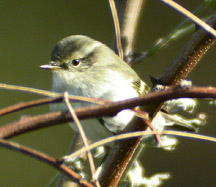
Several records. First May 19th 2000, Gageo Island, Jeollanam Province; second Gageo Island on October 28th 2000; third April 30th 2002, Eocheong Island, Gunsan City, Jeollabuk Province; fourth, May 1 2002, Eocheong Island. Several presumed Hume’s Leaf in October 2002, on both Gageo and Eocheong Islands, with at least 3 on October 29th, and 2 on October 30th at the latter site, when one was photographed.
The Hume’s Leaf Warbler is listed as a separate species from Yellow-browed Warbler Phylloscopus inornatus in the official OBC checklist and by many other authorities, largely due to differences in vocalizations, but also due to fairly consistent differences in plumage and bare part coloration. However, many silent birds probably cannot be safely distinguished from very grey-toned Yellow-browed Warblers, and even vocalisations seem more variable than described in e.g. Robson (2000).
On May 19th 2000, following a passage of a weak cold front, a broad range of scarce migrants were recorded on Gageo Island, including Thick-billed Warbler Acrocephalus aedon and Russet Sparrow Passer rutilans. In the afternoon, a dry "peet" call was heard being given by a small phylloscopus warbler, about 10 m away. Watching the partly-concealed bird at close range through binoculars in reasonable light for about 15 seconds, it looked rather similar to Yellow-browed Warbler (a species which Nial Moores has very extensive experience of, especially in China and Korea).
However, this individual was (1) very grey-toned overall, lacking yellow tones throughout; (2) the upperparts were dull green, tinged grayer, and (3) the face pattern was strongly marked, with perhaps clearer contrast than is typical in Yellow-browed Warbler due to the supercilium lacking yellow tones. (4) The crown was grayer, showing a weak paler center to the rear. (5) The greater covert bar on the closed wing was very strong and broad, while the median covert bar was very weakly marked. (6) The underparts were a dirty-looking white-grey, dingier than shown by many Yellow-browed Warblers. (7) The bill was all dark (lacking any obvious paler on the lower mandible) and the legs darkly pink. All of these features are considered indicative of Hume’s Leaf Warbler (a species that Nial Moores has very limited experience of, from especially Thailand and India).
(8) The "peet" call was repeated 4 or 5 times, and followed by a harder "pit" call as the bird disappeared into cover. A disyllabic call, "tchu-itt", also lacking the obvious sibilance usually heard in Yellow-browed Warbler calls was also given once. On returning to his accommodation, Nial Moores played several tapes, including one made by Paul Holt (an expert on South Asian birds’ vocalizations) and immediately recognized the call of P. humei mandelli as being the same as the "peet" call heard in the field two hours previously.
On October 28th 2000, a similar call was heard only 500 m from the first record, and again a grey-toned phylloscopus warbler, superficially resembling Yellow-browed Warbler was located, and watched for less than 5 seconds. Again, this individual showed a strong greater covert bar and a very poorly marked median covert bar, and an apparently all dark bill and legs. At least one further bird was heard and observed on Eocheong Island on April 30th 2002 (when over 200 Yellow-browed Warblers and at least 5 Two-barred Greenish Warblers Phylloscopus trochiloides plumbeitarsus were also recorded), with a further individual observed by Tony Lancaster and others the next day on May 1, also on Eocheong Island.
Hume’s Leaf Warbler breeds across much of western and central Asia, through much of the Himalayas and also into NW China (Robson, 2000). It is regular each spring in small numbers, probably peaking in late April, on the Hebei coast (J.Hornskov in lit.). Hume’s Leaf Warbler has not yet been recorded in Japan, where even the Yellow-browed Warbler is a scarce species.
The probable status of Hume’s Leaf Warbler in South Korea is unclear, but it perhaps occurs reasonably regularly in April and May as an "overshoot" and in the autumn as a "reverse migrant". Several other individuals seen in South Korea between 2000 and 2002 showed most of the features outlined above, including one watched for about 10 minutes in good light on April 28 2000 on Daeheuksan Island (in the company of Dr. Park Jin-Young). The Daeheuksan bird, however, was most striking for its vocalizations, which apparently did not fit either Hume’s or Yellow-browed Warbler. It called a Hume’s like dry "cheep-cheep", and a more sparrow-like "twee-it", lacking the sibilance of Yellow-browed Warbler, as well as giving most surprisingly several churring calls. Its song, repeated several times, was similar to Yellow-browed but deeper (and thus very different from that described for Hume’s), lacking the final slightly hissy flourish of Yellow-browed.